
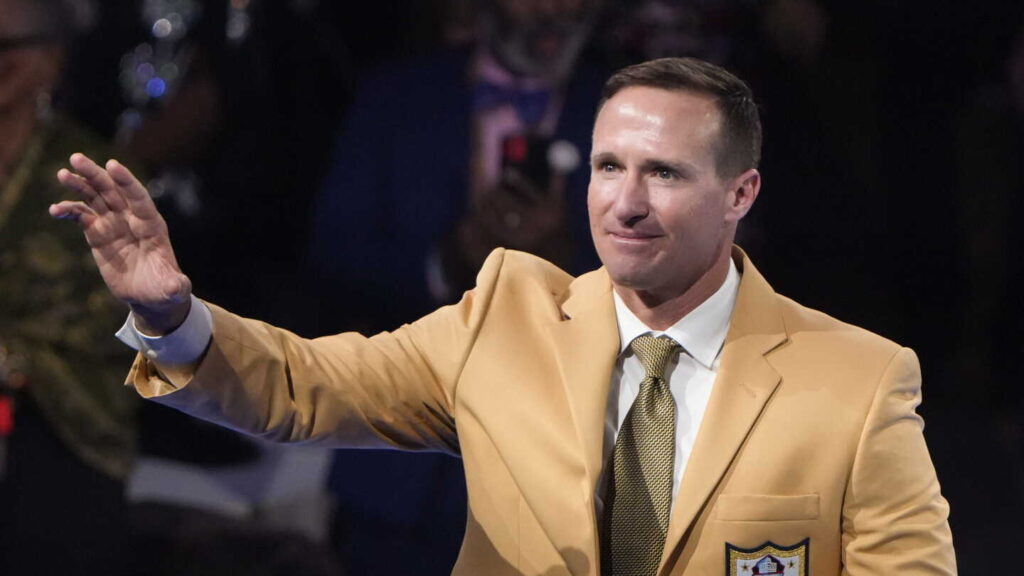
Drew Brees stepped onto the podium in Canton on Saturday knowing he belonged there, though he took a bit more time than the organizers likely anticipated. As the final speaker among five new inductees, Brees transformed his allotted ten minutes into a twenty five minute reflection on a storied career defined by precision and resilience. With 80,358 passing yards and 571 touchdowns to his name, Brees entered the Hall of Fame as a first ballot certainty, yet he chose to spend very little time discussing his own accolades, instead framing the role of a quarterback as an art form and a responsibility to distribute hope and confidence.
The heart of Brees’ address was reserved for those who rebuilt him after his career nearly ended due to a devastating shoulder injury. He spoke with deep gratitude toward former coach Sean Payton, describing himself as an extension of Payton’s brilliance on the field. After being dismissed by other teams during his free agency following that injury, Brees found a home and a mentor in Payton, admitting that he spent years wanting to prove himself to the coach whose trust ultimately allowed them both to achieve greatness together.
Beyond the playbook, Brees focused heavily on the symbiotic relationship he shared with New Orleans. Recalling the aftermath of Hurricane Katrina, he noted how storms reveal that people are far more valuable than possessions. He described the honor of being trusted with the soul of a city that had faced unimaginable loss, arguing that the greatest sports teams are those that serve as true representations of their community. For Brees, playing for the Saints was not just about winning games but about helping a city heal while they helped him save his career.
In an emotional closing tribute to the Who Dat Nation, Brees evoked specific memories that define the era, from Steve Gleason’s iconic blocked punt to the triumphant reopening of the Superdome in 2006 and finally victory in Super Bowl XLIV. He credited the spirit of New Orleans for providing the fuel necessary for those achievements, concluding that anyone who loves New Orleans will find that love returned tenfold. It was less of a victory lap for an athlete and more of a thank you note to a region that embraced him when he was considered damaged goods.