
Two firefighting helicopters collided midair on Sunday while battling a raging wildfire in the Psatha area near Athens, killing both crew members aboard and underscoring the extraordinary danger facing emergency crews across southern Europe as blazes tear through drought-stricken landscapes. The victims were identified as a Greek coordinator and a Danish pilot who were attempting to drop water on a massive fire burning through Porto Germeno, a coastal village roughly 60 kilometers west of Athens. Greek Prime Minister Kyriak Mitsotakis confirmed the deaths in a statement, saying the loss filled the nation with grief and expressing condolences to the families of the fallen crew members. The collision occurred under treacherous conditions, with gale-force winds reaching 100 kilometers per hour creating extreme turbulence that has severely hampered aerial firefighting efforts for days.
The crash came as Greece’s fire service acknowledged being pushed to its absolute limits, with dozens of new fires igniting daily across the mainland and islands. Strong winds continued to drive flames deeper into the region surrounding the capital, forcing fresh evacuations of villages that had already been emptied earlier in the week. By Sunday, wildfires had devastated more than 12,000 hectares of forest and farmland across the country, and Theodore Giannaros, a wildfire meteorologist at the National Observatory, warned that the Porto Germeno blaze alone had scorched over 10,000 hectares, nearly double initial estimates. He said it was almost certain to be classified as a megafire. The disaster adds to an already grim toll for Greek firefighters this season, following the deaths of three other crew members earlier in the week on Crete and in the Peloponnese.
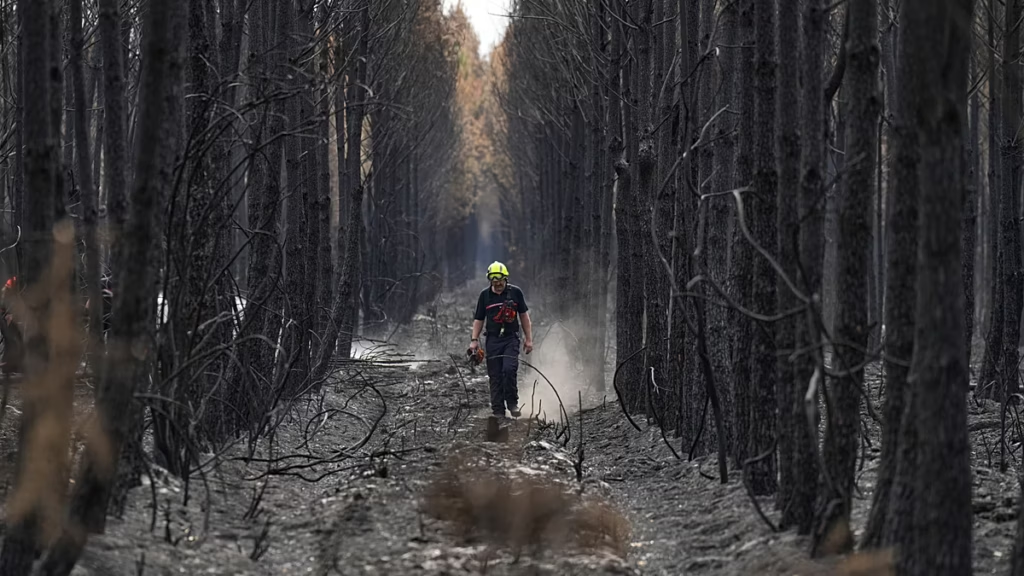
Greece is not alone in facing nature’s fury. France reported that it had finally contained the enormous blaze in the Gironde region near Bordeaux, which has consumed 42,000 hectares and destroyed 240 homes since early July, making it the country’s largest wildfire since 1949. Of the 220,000 people evacuated from threatened areas, more than 208,000 have been allowed to return home. But officials warned that the fight was far from over elsewhere in the country, particularly in the southeastern Var region, where a fast-moving fire that erupted Friday was still being closely monitored amid winds described by one official as spreading flames faster than a galloping horse.
In Spain, authorities lifted a national state of emergency late last week only to see several fires rekindle over the weekend. A blaze in Zamora province flared up again Saturday before being brought under control with heavy aerial support, while new outbreaks emerged in León and Cáceres provinces, triggering fresh evacuations. The major fires that burned across more than 70,000 hectares in Madrid and Ávila remained contained but active. Scientists have linked the succession of deadly heatwaves baking the Mediterranean to human-driven climate change, which has dried out vegetation and riverbeds across the region, turning vast stretches of forest into kindling primed for catastrophe.